A different way to Learn
Why Do Stories Matter?
Why do so many kids disconnect from learning?
Children don’t hate learning.
By default, they love it.
They learn to smile, crawl, walk, talk, build sand castles. All on their own.
But when learning arrives without play, emotion, context, or meaning?
Learning disconnects from them.
Suddenly children and learning don’t speak the same language anymore.
How does Learning Actually work?
Learning ≠ Memorizing
Memorizing facts about something doesn’t mean you’ve truly learned it.
Humans learn by understanding deeply.
Children even more so, they need to experience knowledge.
Through stories.
Through play.
Through exploration and imagination.
This is how knowledge has been passed down for thousands of years.
How can your approach Deepen Learning?
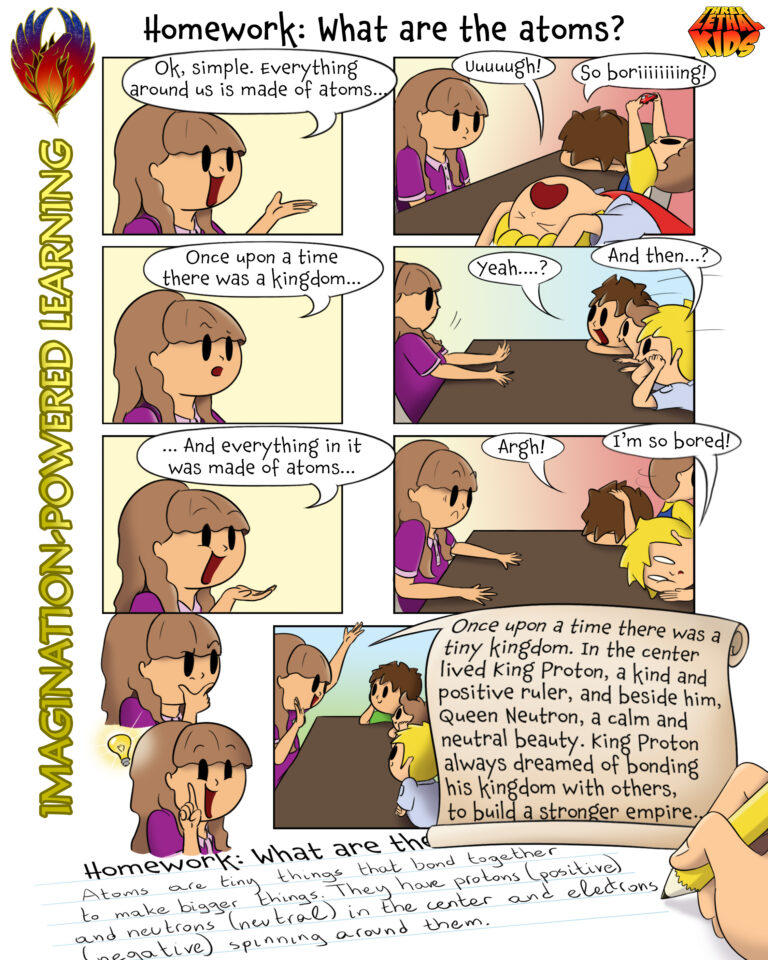
Every subject you want your child to learn hides a great story.
A story they can emotionally connect to.
When that story is revealed, there’s no need for memorization,
because knowledge has automatically been absorbed.
My job is to find that story and bring it to life!
For example...
How does this actually work?
There are three interconnected layers at work in every one of our books:
🟠 Layer 1: The Story
The magic children love.
The characters, the action, the humor.
A narrative that pulls them forward, page after page.
🟣 Layer 2: The Science
The real knowledge beneath the story.
How life, nature, our bodies, and our minds really work.
🟢 Layer 3: The Core Message
The life lessons that naturally emerge.
Confidence, resilience, humanity, trust in nature, teamwork, and balance.
When these three align, kids’ natural, daydreaming imagination empowers learning.
Why Graphic Novels?
When my oldest was in first grade, his teacher told us that he needs to read more.
My husband came up with this brilliant idea: unleash him in a bookstore to choose his first book.
Moments later he came back with John Patrick Green’s graphic novel The Investigators.
He read it in one afternoon.
And then another. And another.
Books are still one of the most powerful learning tools we have.
And graphic novels? They remove fear.
They invite children in visually and emotionally, before asking them to decode text.
For many children, they are the doorway to reading, curiosity, and confidence.
So is this entertainment or educational?
It’s both!
After my son read every graphic novel I could find, I started looking for one that would offer more than entertainment.
I couldn’t find any funny, adventurous graphic novel that taught science.
And I couldn’t find any science book that wasn’t dry facts with speech bubbles.
“Then make one”, my husband said, and this thought couldn’t let me go.
Four years later I finished the book I wished existed, the first one of its kind.
It’s 100% scientifically accurate and told through humor, adventure, and story.
Who Are these books for?
These books are written for:
- Curious kids
- Reluctant readers
- Kids who roll their eyes with the word “learning” or “science”
- Children who love stories
It is also widely enjoyed by parents and educators.
“It’s like a Pixar movie!”, RK – Father of 2
What ages are they for?
Most children who enjoy these books independently are around the ages of 8-11.
But many younger kids love them as read-alouds,
And older kids enjoy the humor and intriguing revelation of the interconnected stories.
Curiosity matters more than age.
Is it aligned with school learning?
These books do not replace school.
By reading these books, your children will be able to fully understand facts and complicated subjects that might seem difficult at first.
By translating scientific language to relatable stories, kids understand and learn intuitively.
Is there anything scary or graphic in the books?
No.
My approach with my children is to be fully honest with them but handle their questions with age-appropriate answers.
In these books I answer their questions with humor, care, and respect.
Wounds, hospitals, germs, and even blood is portrayed in a cartoonish and cute manner (shout-out to our cute little baby blood cells carrying their oxygen balls around).
Why is the book only available through Amazon?
Short answer: The book is only available in Amazon because it’s self-published through Amazon’s KDP direct publishing.
Long answer: After years of working in this book, I had two options. Self-publish it or the traditional path of finding an agent/publisher.
I decided to research both so I can better decide.
So I reached out to publishers and agents to see what “traditional publishing” means.
Seeing how “the sausage is made” was a life-changing experience for me and it scared me to my core.
I spent 2024 reading what 50 different agencies and more than 60 different publishers ask from authors, I took part in competitions, I talked to authors, illustrators, editors, and I immersed myself into this culture.
I witnessed racism, discrimination, propaganda, secret agendas, but more importantly, I saw the people who sell us content for our kids. People who do not care about quality stories or moral values.
If your creation is visually appealing (to their standards), or you are visually appealing (again, to their standards), then they can make money off of you. If not, they won’t even answer you.
Of all these people I reached out to, not even one asked to judge my work. They judged my skin color, my name, my country of origin, the fact that I want to write about science and not fart jokes, and no-one asked to see the actual book.
At this moment I realized that we’re not speaking the same language and we’re in it for different reasons.
I want to give kids a tool to carry for life, to teach them how to learn anything they want and become the best they can be. And I saw my book doing that in front of my eyes.
The dissonance between what parents and kids thought of my work, how warmly they embraced it, and asked for more, and the blind rejection I got from the “professionals” made me realize that this book has to reach children unaltered and pure.
This is why I decided to self-publish and the best way to do it was through Amazon.
Why does the book cost almost 20$?
Amazon’s KDP method is print-on-demand. The moment you order the book, it gets printed locally and shipped to you.
That avoids waste and allows authors like me to exist, but it has a higher production cost.
Right now, the most important thing for me is to allow you to give this book to your children, so I priced it the minimum amount possible, even if it means I will not receive any royalties.
Let's stay in touch
Subscribe to our friends' list:
Free Monthly Comics, News of Mischief and Special Offers from the Three Lethal Kids.
Thank you!
You have successfully joined our family.
Who am I?
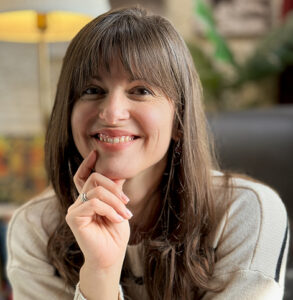
My name is Nina.
I am a mother of three wonderfully curious (and naughty) boys, and I have an MS in Chemical Engineering.
For over a decade, I became known in my town as “the one who rescues the bad students”. Desperate mother that her kid was failing at math or physics would call me to come save them.
What I learned from this is that there are no kids who hate science, but the method we teach them was failing them.
Then I had kids of my own and with every question they asked, I found myself building stories and worlds. And the more I built, the more captivated they became.
That’s when it clicked.
Stories are how humans learn, how we are wired.
Even textbooks are stories, but often told in a way that disconnects children instead of inviting them.
The magic is finding a story a child will fall in love inside any subject.
And immediately learning becomes effortless, intuitive, even fun!
When I couldn’t find a book that worked this way for my own kids, I decided to create one.
I started from scratch, with two toddlers and a tiny baby, climbing all over me, grabbing every spare moment I could to learn, practice, fail, and try again.
Four years later, that baby isn’t a baby anymore and I’m holding a book in my hands.
The same book I gave my children to read!
I made millions of mountains of mistakes, I redid the whole thing 4 times, but I learned a ton.
And honestly, if I had a magic wand, I would place this book into the hands of every child that wants to learn and laugh.
Because I truly believe that our children deserve learning that respects their intelligence, their curiosity, their imagination, and most of all, their love for learning.